

ROADMAP TO THE MULTIPOLAR WORLD
How Russia and China Charted the New Global Order in Plain Sight

The Road not Taken
The multipolar world is neither an accident nor a surprise. It is the inevitable and foreseen result of a road refused at the end of the Cold War, and the two agreements signed in Beijing this May are not only a status report on a project three decades long; they are also a window into how that world will be governed.
The dissolution of the Soviet Union marked the decisive end of the Cold War and the entire post-World War II bipolar global order. Between November 1989, with the fall of the Berlin Wall, and the July 1991 dissolution of the Warsaw Pact and the end of the Soviet Union itself that December, decisions were made by both sides which revealed a fundamental disconnect between visions of the world order to come. Much like Imperial Germany in 1918 prior to the signing of the Armistice ending World War I, the Soviets anticipated treatment as equals; however, again like Imperial Germany, the victorious West imposed a strategy of destruction. This time there was no obviously punitive Treaty of Versailles; there were disingenuous gentlemen’s agreements, strategies of economic exploitation, and most importantly, a refusal to demilitarize and dissolve NATO, even though its raison d’être no longer existed. The West chose domination rather than seizing the opportunity to transform hostilities into shared security interests and a partnership stretching not only from Lisbon to Vladivostok, but into an alliance spanning the globe.
This concept was not outlandish; it was Gorbachev himself who laid out a vision, hearkening back to de Gaulle, of a common European home stretching all the way to the Pacific. He recognized that the end of the war did not necessitate subjugation, but offered opportunity, that the fall of the Wall could mean the end of the East/West divide rather than simply the renegotiation of where that divide lay. The possibility and opportunity were real and the decision of the victorious West to discard this vision and instead pursue a policy of domination and contempt represents perhaps the most revelatory and short-sighted mistake since the Versailles Treaty itself.
Rather than an embrace of equals, NATO reinforced and within a decade began to expand. The divide between East and West did not dissolve, it began to migrate eastward, slowly absorbing the former Warsaw Pact states and inexorably encroaching upon the Russian border itself.
Denied by the West for a generation, yet clearly documented in declassified releases, the Soviet Union agreed to withdraw its troops from East Germany only after securing the promise from US Secretary of State James Baker that NATO would not move, in the famous phrase, “one inch eastward.” A closed-door promise from a recent adversary is not a binding treaty, and Moscow relied on a gentleman’s agreement that the West considered less than legally binding. This difference, in which the Soviets moved forward trusting a common vision the West did not hold, is a pattern Russia would follow repeatedly in its negotiations with the West over the next three decades.
The West, faced with a former adversary defeated yet unconquered, which retained the size, resources, nuclear capabilities and self-image of a great power, was unable to neutralize Russia and the newly born Commonwealth of Independent States, and instead of choosing a path of integration, it opted for a strategy of gradual degradation. This decision was the fork in the road not taken, a path away from Western-oriented multipolarity, in a bid for what would be a short-lived unipolar order. That choice did not prevent a multipolar world; rather, it ensured the shift of the center of gravity of multipolarity would move from Europe to Eurasia. Russia responded to what it viewed as the perfidy of the West not by restarting the Cold War, but by drafting a blueprint for multipolarity and drawing a roadmap with China which much of the world has been following for almost three decades.
Two Different Types of Harvard Men
The West’s bid for global hegemony was not immediately obvious to Russia, and Western attitudes regarding Russia’s place in the post-Cold War era were perhaps revealed first through economics. After the collapse of the Soviet model, Russian economic life required wholesale restructuring and this involved two very different approaches. The first approach was to help and to provide immediate and direct proactive assistance. Harvard economist Jeffrey Sachs, fresh from designing Poland’s successful transition from a managed to a market economy, and benefiting from having a seat at the table of Russia’s ultimate decision-makers, prescribed for Russia precisely what had already succeeded in Poland: large-scale Western financial support, long-term debt-relief, a pause on debt-servicing, and a fund to stabilize the ruble, just as had been done for the Polish zloty. The G7, United States government, and the IMF had provided all of these to Poland and, per Sachs, Washington and Europe flatly refused to do the same for Russia.
One month prior to the ultimate dissolution of the USSR, Yegor Gaidar, then-Deputy Prime Minister for Economic Policy and Minister of Economy and Finance for the Russian Republic (the RSFSR), requested from the G7 a pause on debt servicing. He was not only refused but threatened, reportedly told that emergency food aid would be halted, literally turned around and sent home, should Russia fail to pay what it owed when it was due. Sachs pressed his case, ultimately resigning in protest after determining that the West did not truly consider the Cold War to be over and was pressing for economic hegemony by deliberately withholding from Russia the help freely extended to Poland. Sachs reveals this to have been a choice, a strategy, and not an accidental blunder. The economic catastrophe which befell Russia in the 1990s was not the inevitable result of the “shock therapy” reorientation to a market economy; it was the result of being denied the tools to manage the transition which left the Russian economy prey to another sort of intervention, also from Harvard.
The infamous “Harvard Boys” came next and their objective was more acquisition than assistance. Named by scholar Janine Wedel and kept famous by analyst Alastair Crooke, this group of advisers, many of whom were associated with Harvard’s Institute for International Development, controlled the passage of tens of millions of dollars of American aid, and they focused on the privatization of Russian state assets. Through a system of rapid sales, of which loans-for-shares was the most notorious episode, the Harvard Boys created an oligarchy rather than a property-owning democracy. Through their actions, the industrial base of the Soviet economy was transferred, at a fraction of its value, to a small handful of well-placed men. Some of the very advisers entrusted with building Russia’s new economy enriched themselves through the access it afforded, self-dealing that would end with the Harvard Boys in an American courtroom. In Russia, the oligarchs took center stage.
For countless millions of ordinary Russians this resulted in personal catastrophe. Hyperinflation erased savings, production halved, life expectancy collapsed, and premature deaths numbered in the millions. By the end of the decade, Russia had defaulted. Western economic assistance had turned out to be a strategy to ensure weakness and division with no regard whatsoever for the Russian people or for Russia’s historic place in the world. Russia absorbed the blow and the lesson, which was reinforced by the West’s political actions on the Russian periphery.
More Than an Inch…
Economic exploitation did not take place in a vacuum; it was accompanied by consistent Western resistance to Russian overtures, and eventually, to Russian warnings. As verified by former Secretary General of NATO George Robertson, on multiple occasions Russian President Vladimir Putin raised the possibility of Russia joining NATO itself. Putin stated publicly, in 2000, that he considered Russian membership in NATO to be “conceivable” and he recalled mentioning the possibility in a conversation with US President Bill Clinton, who did not object, although the discomfort of the US President’s entourage was evident. Russia never directly applied and was never directly rejected but the idea was floated repeatedly and greeted with a discomfort wholly appropriate to an organization designed to counter Russian power.
The Russians were not blind to this attitude nor were they too weak to protest officially at every hint that the West was turning its back on the promise not to expand NATO eastward. In late 1994, as the short-lived “Partnership for Peace” morphed into what Jeffrey Sachs calls a “neoconservative” project for NATO expansion into Central Europe, Boris Yeltsin directly confronted Clinton and other Western leaders at the Budapest Summit warning that moving NATO eastward threatened to push the continent into a “cold peace.” He was ignored. In spring 1999, NATO welcomed Poland, Hungary, and the Czech Republic into its ranks and within less than two weeks began a bombing campaign against Yugoslavia, against strenuous objection from Russia and without United Nations Security Council authorization, driving Yugoslavian forces from Kosovo, which would declare independence years later and host one of NATO’s largest military bases. It was a revelatory moment, in which NATO showed that it was willing and able to attack a Russian ally, a country which had not attacked any NATO member, and to do so without UN backing and expressly against Russian opposition.
Despite this, Russia again extended its hand to the United States, specifically after the attacks of September 2001, offering expanded partnership and cooperation in the newly declared “Global War on Terror.” Yet, a mere three years later, in 2004, NATO expanded again, this time to Russia’s borders in the Baltics. By 2007, Russian President Putin took more direct action in what may be his most famous international speech, given at the Munich Security Conference. Putin declared that a unipolar world was unacceptable and impossible and the very concept was destructive. His pointed question of “against whom, precisely, was NATO enlargement directed?” referenced the broken promises made not to expand NATO. His speech was accompanied by distinct Russian policy changes in Europe and it also marked the anniversary of the beginning of a new partnership with China, quietly signed a decade before.
Putin’s position regarding NATO expansion was not uniquely Russian; it was held by famed diplomat George Kennan, future Central Intelligence Agency Chief William Burns, and Clinton Defense Secretary William Perry. Kennan, the architect of the victorious Cold War strategy of “containment,” called NATO expansion the most fateful error of American post-Cold War policy and accurately predicted that it would poison relations between the two countries. Burns, then-US Ambassador to Russia, penned the famous “Nyet means nyet” cable highlighting the very real Russian red line of NATO expansion to Ukraine and Georgia. Perry considered resignation. Yet in 2008, at the NATO summit in Bucharest, Romania, both countries were publicly named as future members. Russia’s response went beyond rhetoric and a five-day war in Georgia, instigated by Tbilisi, swiftly showed the consequences of breaching its red lines. The West, notwithstanding its promises to Georgia of NATO membership, did not intervene.
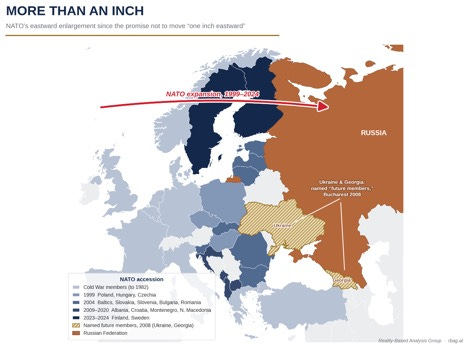
NATO’s eastward enlargement, 1999–2024, with Ukraine and Georgia named as future members at Bucharest in 2008.
The patterns were clear and the behavior consistent; from finance to politics to war in the Balkans, the West noted Russian objections and then pushed past them, in each instance weakening Russia’s interests, whether economic, political, or strategic.
The Inevitable
Throughout this time, Russian strategic thinking recognized that the unipolar moment was inherently temporary and that multiple centers of power across the world were a reality not only of history but of inevitability. American-style unipolarity revealed itself from its earliest moments to be overambitious and significantly beyond capacity; Russia, understanding itself as what would later be called a “civilization-state,” had every expectation that it would eventually rise again and resume what it considered to be its rightful place in the world order. Russia also knew that the decades of diplomatic, economic, and military assistance and development invested by the Soviet Union across the world had left constituencies across Africa, Asia and Latin America not only sympathetic to Russia’s worldview, but more eager to participate in a multipolar world order as equals than to be managed, as junior partners at best, in what would later be known as the Western-led “rules-based order.” From Russia’s perspective, even in the earliest years of rebuilding the multipolar world, featuring civilization-states such as Russia and China as its anchors was a more natural development than a world run by a central power and organized through the architecture of colonialism.
Russia recognized China as a fellow “civilization-state,” defined not only as a country with its own history, language and culture, but as an irreducible cardinal member of the community of nations. A civilization-state can be nothing less than a pole, and a world with multiple civilization-states must inevitably be organized as multipolar. Russian perception of consistent contemptuous treatment by the West, and a failure to be recognized for who it recognized itself to be, led inevitably to the coming together of the two great powers dominating Eurasia. In a world in which the “Global South” was predisposed to multipolarity and the two great civilization-states straddled the Eurasian “World Island” and shared one of the world’s longest borders, overtures between Russia and China were not only obvious, they were inevitable. It began, officially, in the spring of 1997. Western hubris, basking in its unipolar moment, paid it little to no attention.
The Initial Roadmap
The Soviet Union had dissolved only a half-decade before and Russia remained deep in the beginning of its long rebuilding process when Chinese President Jiang Zemin and Russian President Boris Yeltsin signed a declaration in Moscow on 23 April 1997. Civilization-states are not known for impetuosity and the “Russian-Chinese Joint Declaration on a Multipolar World and the Establishment of a New International Order” stands as a remarkable forecast for the world to come, especially from the vantage point of the late 1990s when the unipolar world was at the pinnacle of its power. The Declaration is the initial roadmap to a multipolar world and Russia and China have been steadily advancing along it, joined by an ever-growing caravan of nations. Although the West dismissed or ignored it, Russia and China circulated the document officially to the United Nations General Assembly and Security Council. The covering letter was signed by the then little-known permanent representative to the United Nations, Sergei Lavrov, the now towering figure in Russian diplomacy signing the descendants of this document today.
The Declaration was not a work of prescience predicting the world to be; it was a prescription, a formula and it laid down in clear prose the vocabulary which both governments continue to use, at times verbatim, almost thirty years later. The 1997 document demands mutual respect for sovereignty and territorial integrity, non-interference, and peaceful coexistence. It emphasizes that no country should pursue hegemony or demand unilateral management of international affairs. It names a new universally applicable concept of security and rejects the Cold War mentality of dividing the world. The Declaration warns against bloc politics and the enlargement of military alliances. Detailing the architecture of multipolarity, it names the developing world and Non-Aligned Movement as the forces inevitably leading toward multipolarization and it recognizes the United Nations and the Security Council as paramount in its governance.
Read alongside the two documents signed in Beijing in May 2026, the continuity is not only obvious, it is nearly verbatim. 1997’s “new and universally applicable” concept of security has become 2026’s “indivisible and equal security.” The injunction against monopolizing international affairs is now the principle of “democratization of international relations.” Even the title of one of the two 2026 documents, the “Joint Declaration of the Russian Federation and the People’s Republic of China on the Establishment of a Multipolar World and a New Type of International Relations,” had its genesis in the 1997 description of the Russian-Chinese partnership as a “new type of long-term inter-state relations…not directed against third countries.”
The 1997 blueprint for multipolarity was an architecture for both partnerships and institutions. It referenced the agreements then underway between Russia, China and the “new” Central Asian states of Kazakhstan, Kyrgyzstan, and Tajikistan then called the “Shanghai Five,” the precursor to today’s Shanghai Cooperation Organization. Yet importantly, as Yeltsin himself explained, the declarations create no defensive obligations, no alliances, no blocs, but rather bonds of friendship and cooperation. This language recurs in 2021 when China and Russia clarified their relationship as an interaction “exceeding” traditional military or political alliances, repeated yet again in 2026. In a world in which a unipolar power can be counted upon to resist the inexorable multipolar drive, violence is expected and the choice to avoid binding military alliances was a critical and purposeful decision, preventing the expansion of conflicts, such as that in Ukraine, from regional to global conflagrations.
Yet perhaps the most remarkable aspect of the two documents is that the primary difference between the 1997 and 2026 documents is not the content, it is the tense. The 1997 Declaration put a stake in the ground and provided a roadmap for the upcoming “new” “multipolar era,” upon whose “threshold” they stood. By 2026, the Joint Declaration abandoned the future tense and embraced the present, describing a “long-term state of polycentricity.” The roadmap to multipolarity was written in 1997; by 2026 Russia and China declared that they had followed it to its destination.
From Blueprint to Building
The first and the latest documents do much more than repeat shared concepts and language and they do not stand alone. They bookend a series of official statements, each a signpost, each marking distinct developments and mapping out new objectives. Each is both a status report and an invitation; and each delivers a new version of the multipolar blueprint, one in which ideas have turned into organizations, and plans have become partnerships.
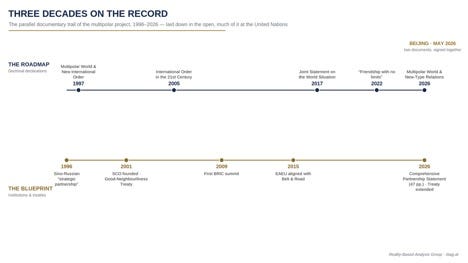
The two parallel document tracks of the Russia–China multipolar project, 1996–2026.
One set of documents lays out the doctrine and details the multipolar world Russia and China intended to bring to fruition. After the 1997 Declaration came the July 2005 “Joint Declaration on the International Order in the Twenty-First Century,” the “Joint Statement on the World Situation” of July 2017, and the February 2022 “Joint Statement on International Relations Entering a New Era.” This document, signed in Beijing, with full knowledge of the likelihood of imminent conflict in Ukraine, announced a “friendship with no limits” between China and Russia. Each of these documents is cited by name in the preamble of the May 2026 Joint Declaration. The string of documents represents consistent progress toward shared objectives; it is the roadmap we are still following.
The second, parallel, set of documents contains the blueprints. Here the architecture of the multipolar world is declared and then built. It began even earlier, in 1996, with the Sino-Russian Joint Statement of “strategic partnership, equality and mutual trust.” Five years later, the July 2001 “Treaty of Good-Neighbourliness, Friendship, and Cooperation” provided the legal framework of the partnership, updated in 2021 and again on its 25th anniversary in the spring of 2026. In between were multiple bilateral agreements, each advancing elements of the shared vision, such as global strategic stability and the authority of international law.
The institutions managing the multipolar transition became tangible. The Shanghai Five grew to become the Shanghai Cooperation Organization and now counts India, Pakistan, and Iran among its members, thus representing the vast majority of the Eurasian population. The BRICS nations, once an economist’s shorthand reference, became a tangible and growing formal membership organization of its own, spanning the globe and expanding well beyond its acronym. While BRICS is by no means a unified bloc, it has sufficient coherence for global economists to take seriously BRICS discussions on de-dollarization via a potential new currency. Already Moscow and Beijing settle the vast majority of their trade together in their own currencies, insulated by design to protect against Western sanctions and punitive economic policies. Bilateral trade grew from a footnote in 1997 to over two hundred billion dollars per year by the end of 2025. The Power of Siberia pipeline of 2019 is being followed up with a second and much larger sibling (The Power of Siberia II) fast-tracked after the destruction of the Nord Stream Pipeline and the US-Israeli attacks on Iran in early 2026. Once unfathomable, Russian-Chinese joint military exercises have been routine for decades.
The parallel progression detailed by these documents, each announced, celebrated, and often circulated at the United Nations, demonstrates a patient public reordering of the world, one whose momentum was both tangible and undeniable. They detailed, publicly and explicitly, a program in which goals and intentions were stated clearly, followed up on, achieved, and then new objectives were laid out; all in inexorable pursuit of a multipolar world order the prime movers considered inevitable. Visible to all who would see it, the West chose blindness until February 2022, the month marked both by the announcement of the Russian-Chinese “friendship with no limits” and the outbreak of open hostilities between Russia and Ukraine. Only then did Western policymakers take seriously the partnership. Misreading the February 2022 “Joint Statement” as a reactive statement on current affairs rather than the deliberately timed culmination of a decades-long partnership in progress, the West unsuccessfully sought to drive a wedge between the two countries. It failed completely, and to Western consternation, their attempts to destroy the Russian economy after the 24 February 2022 Russian invasion of Ukraine, and especially after the successful Western sabotage of the promising Istanbul Peace talks of March 2022, resulted in the acceleration of Russian integration into the very institutions they had been building with China over the prior decades. The critical decision, made in 1997 and reiterated throughout the decades, that the partnership was not a military alliance and that the multipolar project was not a military one proved its wisdom and prevented the conflict in Ukraine from escalating unnecessarily into one involving China.
By the time Vladimir Putin signed the two documents in Beijing with Xi Jinping, the exercise was not one of forecasting a multipolar world to come. The parallel documents continued, but they now describe the management of the world that is, rather than one that would be.
The Latest Status Report
The two documents signed in May 2026 in Beijing again reinforce the doctrine of multipolarity and update its tangible architecture. The shorter of the two documents, the “Joint Declaration on the Establishment of a Multipolar World and a New Type of International Relations,” reiterates and updates the current status of the multipolar world order as having indeed arrived*. The longer, more comprehensive 47-page document is the “Joint Statement on Further Strengthening Comprehensive Partnership and Strategic Interaction and Deepening Relations of Good- Neighbourliness, Friendship and Cooperation,” and it is a catalogue of the instruments through which China and Russia envision how that world is to be governed.
The shorter document, a manifesto of sorts, confidently states four cardinal principles as nonnegotiable. Better put, it presents these principles yet again, as each of them is a more confident and declarative restatement of the same four ideas presented in 1997. First is the importance of inclusive and mutually beneficial cooperation among nations; the insistence on equality of states and a recognition that there shall be no permitted hegemons or countries considered superior to others. Second is the evolution of the 1997 idea of the “new concept of security” now updated as “indivisible and equal security.” This includes an objection to proxy wars and expanding alliances, NATO foremost among them, though never named. Third is the democratization of international relations, directly addressing 1997’s prohibition on monopolizing world affairs and aiming squarely at the once unipolar hegemon. The fourth is an explicit recognition of civilizational and value differences among peoples and nations, and the rejection of any one culture’s claim to universal moral norms. In 1997, these statements were aspirations; in 2026 they are affirmations of the status quo. No longer are Russia and China arguing for the need for multipolarity; they are describing the world as it actually is. Notably, the vocabulary used in the description, though signed by Russia, is primarily Chinese. This subtle linguistic aspect of the documents hints that the center of gravity of multipolarity continues migrating eastward and that the World Island puts its emphasis on the second syllable of Eurasia.
The 47-page Joint Statement on Further Strengthening Comprehensive Partnership and Strategic Interaction is a strikingly different document from the shorter manifesto. It lays out in clear and explicit detail four different broad topics germane to global interaction and the mechanisms proposed to address them. The first topic is financial. The Statement implicitly advances global de-dollarization and refers to the settlement of international trade in national currencies as something to continue rather than something to achieve. It explicitly condemns any freezing or seizing of sovereign reserves as unlawful and asserts the right of reciprocation in cases in which this takes place. This is clearly a reference to the serial Western seizures of the sovereign reserves of Venezuela, Iran, and particularly Russia, among others. These provisions speak to the creation and maintenance of an alternative global financial system, independent of the dollar and buffered against financial measures and punishments imposed by the West.
The second topic is security. The Statement commits the Chinese Global Security Initiative and Russian initiative for a Eurasian Security Architecture to explore a potential merger. This is perhaps the most explicit signal in the entire document of the direction of the Russian-Chinese partnership. It is still committed to not being a military or defensive alliance, with all the commitments and concomitant risks that entails. Rather, it is a signal of a unified Eurasian security space, designed to be clear of the archipelago of foreign military bases dotting the rest of the world.
The third topic details the institutions of governance. A ten-year strategy for the Shanghai Cooperation Organization (SCO) is laid out and overlaps with the financial topic by including consultations for an SCO bank of its own. The chairmanship of the ever-expanding BRICS is noted to be passing from India to China next year. A new “Greater Eurasian Partnership” is revealed to be the alignment of the Eurasian Economic Union with China’s Belt and Road Initiative. Further, it pledges support for the Union State, currently composed of Russia and Belarus, and its development with respect to promoting peace, stability and prosperity in the region.
The fourth topic is explicitly doctrinal. The Statement condemns in clear and precise language the assassination, abduction, or forced trials of heads of state and the concept of “regime change.” It lays out clear positions on limitations of the military application of artificial intelligence and it warns of American missile-defense programs. These declarations position the multipolar project squarely within the norms of International Law and International Humanitarian Law (the Law of War) and draw a stark differentiation between themselves and the unipolar rules-based order they purport to have obviated.
Together, the parallel documents signed in May 2026 give an update not only of where Russia and China view themselves and the world to be, a status report of sorts; they also lay out in detail how they view themselves and others actually governing in the world today and tomorrow. As such, they allow a glimpse into what both powers anticipate for the future.
Where the Road Leads
Carrying the credibility of their predecessor documents with them, the Statement and the Declaration signed in Beijing in 2026 point the direction Russia and China anticipate the multipolar world to take prior to their next installment of documents on the record. The documents themselves are a sort of prospectus, which allows reliable forecasting and extrapolation as to where the road forward is likely to lead. None of this should be surprising to any careful observer, or anyone who has noted the steady progress of the multipolar project, often documented at the United Nations, and reinforced by real-world developments.
First, expect accelerated de-dollarization in Eurasian trade. Expect a steady increase in non-dollar-denominated business exchanges and the increased use of non-SWIFT transactions and other financial mechanisms designed explicitly to obviate the tools of Western economic coercion. Expect firm pushback against unilaterally imposed Western sanctions. Expect a slow and steady approach, typified by Russia’s proposed BRICS grain and commodity trading platform. Do not expect abrupt ruptures but instead a steadily growing alternative financial system.
Second, expect the Shanghai Cooperation Organization to expand its role and reach, not only as a political entity, but as an economic mover. The ten-year strategic plan and consultations on creating an SCO development bank signal the eventual emergence of a new economic center of gravity in the Global South.
Third, expect a robust diplomatic and legal campaign surrounding the issue of seized sovereign assets. Russia has laid the groundwork not only for a lengthy effort to recover its frozen funds, but to use the issue politically to advance de-dollarization in general.
Fourth, expect unified pushback against uses of force in violation of the UN Charter, with specific focus on the protections of civilians as well as heads of state. Expect condemnations of the crime of “aggression” and unilateral attempts to dictate local or regional policy by States outside the region.
Fifth, expect further progress in efforts to unify Russian and Chinese security initiatives in Eurasia. Do not expect a military alliance, for the same reasons stated clearly for 29 years, but expect a solidifying security posture which allows no space for Western military adventurism or control.
Sixth, expect that upon the conclusion of the conflict in Ukraine, the settlement that is ultimately reached will echo the themes present in this decades-long roadmap: root causes, indivisible security, friendship, good-neighbourliness, cooperation; not simply territory.
Seventh and last, expect that opposition to American missile defense policies and the militarization of artificial intelligence will continue to grow, although in what way remains unclear.
The documents are a roadmap, but they do not provide a timeline. The forecast from the original documents starting almost 30 years ago was for the multipolar world itself. The above forecast from the 2026 documents is a fine-tuning exercise on the administration of a multipolar global order. The road from the unipolar moment to today and the three decades of institution building and the consolidation of the Global South around two great civilization-states began with refusal and rejection. Western hubris prompted Russia to create with China a road not taken by the West and that has made all the difference. The same hubris allows them to deny that the world is multipolar at all and to dismiss or ignore the documents signed this May in Beijing. Ultimately, as the center of gravity of world power and influence steadily shifts eastward, the West and its supplicants will be the only ones surprised when they too realize they have arrived at the destination: the multipolar world.
*I am indebted to Geoffrey Roberts’ translation published by Pascal Lottaz at his Neutrality Studies Substack: https://pascallottaz.substack.com/p/russia-and-china-issue-declaration
Joseph Busby is the Founder and Director of Reality-Based Analysis Group (RBAG), an independent geopolitical analysis firm based in Vienna, Austria. RBAG is affiliated with the Association for the Promotion of International Development and Stability (APIDS — apids.at). Subscribe at rbag.at.
© 2026 Joseph Busby / Reality-Based Analysis Group. Licensed under CC BY-ND 4.0. You may reproduce this work in full with attribution to Reality-Based Analysis Group and a link to rbag.at.